
Core Training Basics: A Beginner-Friendly Guide to Building a Stable Midsection
Learn what your core actually does, how to train it with four simple floor exercises, and how to fit them into a week of training.

Core training gets a lot of attention, but it is often reduced to endless crunches. Your core is better understood as a group of muscles that work together to support and control your spine and pelvis while your arms and legs move. Training it well does not need fancy equipment or long sessions. This guide covers what the core is, the principles behind good core work, and four basic exercises you can do on a mat at home.
What the core actually is
The core is not just the abdominal muscles you can see in the mirror. It includes the muscles at the front of the trunk (such as the rectus abdominis and the deeper transverse abdominis), the obliques at the sides, the muscles along the spine, and the muscles around the hips and pelvis. The diaphragm and pelvic floor are often included as well.
These muscles work as a team. One of their main jobs is to keep your trunk steady so force can pass between your upper and lower body, whether you are carrying groceries, standing up from a chair, or doing a squat. Because of this, a lot of good core exercise is about resisting movement rather than creating it.
Three principles that make core work effective
First, brace gently and keep breathing. Bracing means lightly tightening the muscles around your midsection, as if preparing for a light tap to the stomach. It should not be a maximal squeeze, and you should never hold your breath for long. If you cannot breathe normally during an exercise, it is too hard or you are overtensing.
Second, think about control rather than speed. Slow, deliberate repetitions let you notice whether your lower back is arching or your hips are shifting. Quality matters more than the number of reps, and stopping a set when your form changes is a sensible rule.
Third, train the core in different ways. Resisting extension (as in a plank), resisting rotation (as in a bird dog), and resisting side bending (as in a side plank) all challenge the trunk differently. A small mix of these gives a more complete base than repeating one movement.
How core work fits into your week
Public physical activity guidance for adults recommends muscle-strengthening activities on two or more days per week that work all the major muscle groups, alongside regular aerobic activity. The abdomen and back are commonly listed among those major groups, so core exercises can count toward this, and they also get worked during squats, deadlifts, carries, and push-ups.
For most beginners, two or three short core sessions per week is a reasonable starting point, either added to the end of a workout or done on their own. Five to ten minutes is enough when you are starting out. Leave at least a day between harder sessions if you feel sore, and increase difficulty gradually by adding a few seconds or a few reps over several weeks.
Common mistakes to avoid
Letting the lower back sag or arch is the most common problem in planks and similar holds. If this happens, shorten the hold, make the position easier (for example, plank from the knees), or take a rest.
Rushing is another one. Swinging the legs in a dead bug or flinging an arm in a bird dog turns a control exercise into a momentum exercise. Keep movements smooth.
Finally, avoid judging progress by soreness or by how much you can do in one session. Consistent, well-performed practice over weeks is a better guide than how tired you feel afterward.
A simple routine to start with
Do the four exercises below in order, resting 30 to 60 seconds between sets. You only need a mat or a carpeted floor. Begin with one or two rounds and add a round only when the work feels controlled and comfortable. Choose the lower end of each range if you are new to exercise.
Exercises
Dead bug

Sets and reps: 2 sets of 6 to 10 slow reps per side
Lie on your back with arms pointing to the ceiling and hips and knees bent at 90 degrees. Gently brace so your lower back stays comfortably in contact with the floor. Slowly lower one arm overhead and the opposite leg toward the floor, then return and switch sides. Move only as far as you can without your back arching. To make it easier, move just the legs or just the arms.
Bird dog

Sets and reps: 2 sets of 5 to 8 reps per side, with a 2 to 3 second pause at the end of each rep
Start on hands and knees with hands under shoulders and knees under hips. Keep your spine in a neutral, flat position. Extend one arm forward and the opposite leg back without letting your hips tip or your ribs flare. Reach long rather than high. Return slowly and switch sides. If balance is difficult, extend just the leg or just the arm.
Forearm plank
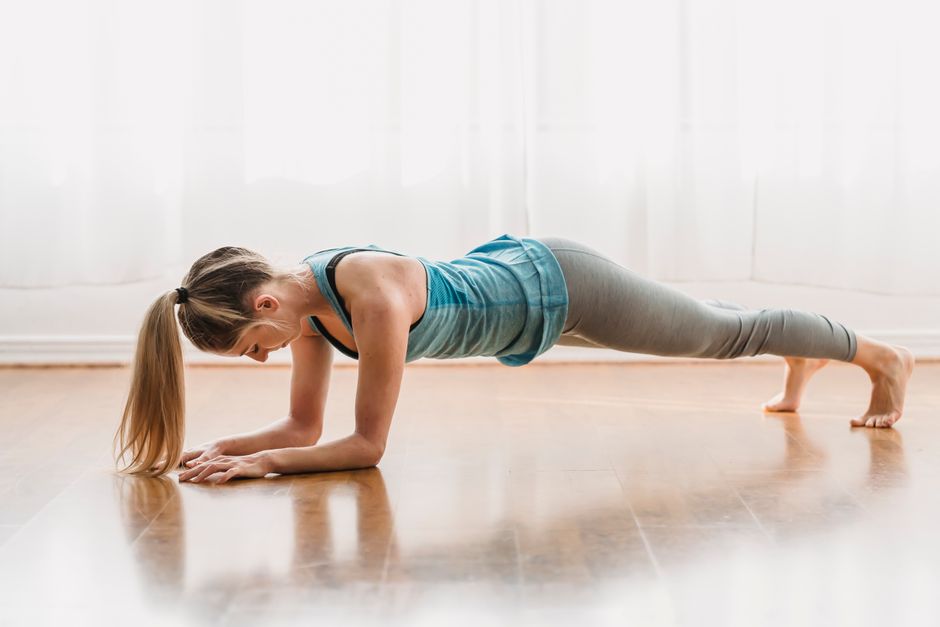
Sets and reps: 2 to 3 holds of 15 to 30 seconds
Place forearms on the floor with elbows under shoulders. Form a straight line from head to heels, with a light squeeze in the glutes and abdomen. Breathe steadily. End the set when your hips sag or pike. Perform it from the knees if the full version is too difficult, and increase the time gradually across weeks.
Side plank
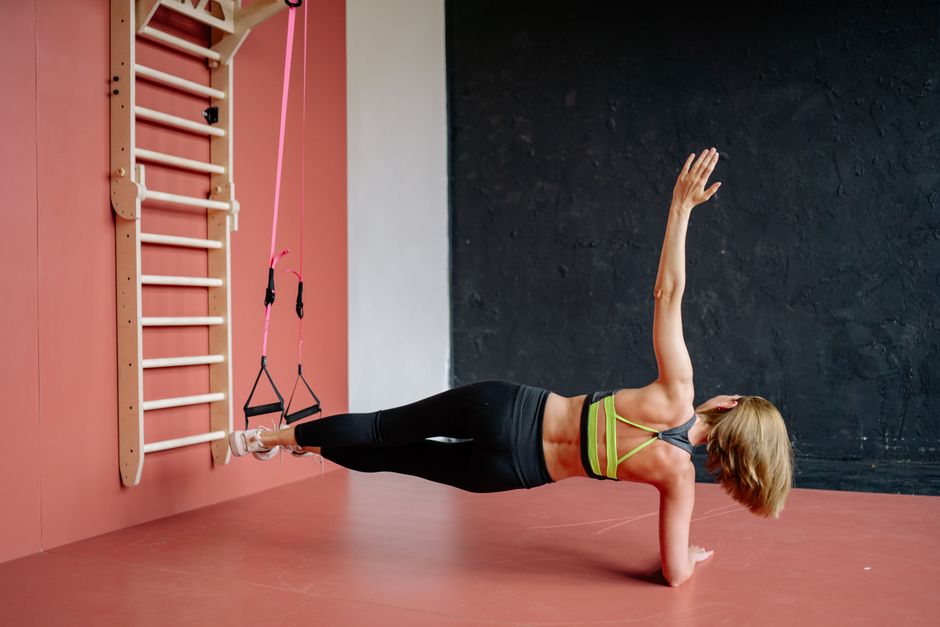
Sets and reps: 2 holds of 15 to 20 seconds per side
Lie on your side with your elbow under your shoulder and legs stacked, or with the top foot placed in front of the bottom foot for more stability. Lift your hips so your body forms a straight line. Keep your neck relaxed and breathe. Bending the knees and lifting from the knees is a good easier option.
This article is general information, not medical advice. Talk to a doctor or qualified professional before starting a new exercise program.